

Ayurvedic Majun is based on the three doshas. It is prepared using herbal combinations with sugar or jaggery, and ghee and honey are added at set stages during the process.
Unani Majoon is based on mizaj, which refers to the body's hot, cold, moist or dry temperament. This paste is made from powdered herbs (safoof) mixed with honey or sugar syrup (qiwam).
The ingredient lists for both types of preparation are similar, but their beliefs, methods and ways of preparation differ. Neither one should be taken without guidance, and neither has been proven through scientific trials in the same way that medicines are tested.
What does "Majun" actually mean?
I find this point confusing. This is the point that most articles skip and that point causes most of the confusion.
Majun, also written majoon or ma'jun is a word that means "paste" or "electuary". Majun entered use through Unani medicine. Unani pharmacy treats Majun as a method of making a formulation, not as one remedy. Powdered herbs are blended into a base and that sweet base also masks bitter tastes. Meaning of Majun is explain in this article where you will understand the complete meaning.
Ayurveda has its classical term for the same kind of preparation: avaleha also called leha or lehya. The word comes from the Sanskrit root lih, meaning "to lick" because these pastes were traditionally taken by the spoonful. Chyawanprash is the best‑known example of this type of paste.
So when a brand sells an "Ayurvedic Majun" that brand is using the market word for an avaleha‑style Ayurvedic herbal paste. Both traditions make semi solid herbal confections. The difference lies in the theory the method and the licence behind each tradition.
A note, on spelling: "majoun" is also a sweet that is sometimes made with cannabis. That has nothing to do with the Ayurvedic or Unani products discussed here which are licensed preparations.
What is Unani Majoon?
Unani medicine comes from the Greek system started by Hippocrates and Galen. Later Arab and Persian doctors like Ibn Sina also known as Avicenna expanded it in his book Al-Qanoon fi al-Tibb. This tradition became widely used in India over time.
A traditional Majoon is made in two steps.
-
First is Safoof: Each herb is dried carefully then ground into powder. These powders are then mixed together in the proportions.
-
Second is Qiwam: Sugar or honey is used, with a little water or gum to make a thick syrup. The consistency must be just right—neither too thick nor too thin.
Then the powdered herbs are added slowly into the syrup, stirring all the time until the mixture becomes smooth and even. The final product is stored in a jar to keep it fresh. Because the whole herb is used in form this kind of medicine is different from distillates, called arq or liquid extracts. It keeps the nature of the herbs.
Some known examples of Majoon include Majun Falasfa, Majun Jalali and Majun Arad Khurma. These are still used today in healing practices.
What is Ayurvedic Majun (Avaleha)?
The Ayurvedic Pharmacopoeia of India describes avaleha as a semi-solid preparation made with jaggery, sugar or sugar candy, boiled with herbal juice or decoction. Ghee or oil, if the recipe calls for it, is added while the mixture is still hot. Honey is added later, after it cools. Fine herbal powders are mixed in at the specified stage.
Two details matter:
-
Doneness is judged by classical signs. Texts describe leha siddhi lakshana, the signs that the paste has been cooked correctly.
-
Honey and ghee are not heated together. The classical process is designed around this rule.
Well-known examples include Chyawanprash, Drakshavaleha and Panchakola Avaleha. Ayurveda calls many of these pastes rasayana, preparations taken regularly over time, which is the reason they are usually described as daily tonics and not quick fixes.
Doshas vs humors: the theory behind each
Ayurveda describes the body through five elements that combine into three functional energies (doshas): Vata (movement), Pitta (transformation and digestion) and Kapha (structure and stability). Everyone has all three, in an individual ratio called prakriti. Herbs are chosen to suit that balance.
Unani describes the body through four humors (akhlat), each carrying two of four qualities, and a person's overall temperament (mizaj) is the blend:
|
Humor |
Unani name |
Qualities |
|
Blood |
Dam |
Hot and moist |
|
Phlegm |
Balgham |
Cold and moist |
|
Yellow bile |
Safra |
Hot and dry |
|
Black bile |
Sauda |
Cold and dry |
Unani also grades each herb by degree (for example, saffron is described as hot in the second degree and dry in the first), so a formulation is built to fit a temperament.
The two systems arrived independently at a shared idea: people differ constitutionally, so one product does not suit everyone.
Ayurvedic Majun vs Unani Majoon: side-by-side
| Point | Ayurvedic Majun (Avaleha) | Unani Majoon |
|---|---|---|
| Tradition | Ayurveda, Indian, Sanskrit texts | Unani, Greco-Arabic, Arabic and Persian texts |
| Classical name | Avaleha, leha, lehya | Majun (Arabic ma'jun, "paste") |
| Meaning of the word | Sanskrit lih, "to lick" | "Paste" or "electuary" |
| Core theory | Three doshas, prakriti | Four humors, four qualities, mizaj |
| Typical sweetener | Jaggery, sugar or sugar candy | Honey or sugar syrup (some use jaggery or raw sugar) |
| Ghee and honey | Added at specified stages, often both | Honey as a common base; ghee is not the defining feature |
| Method | Herbal decoction or juice cooked down with sweetener, then ghee, honey and powders added | Herb powders (safoof) mixed into prepared syrup (qiwam) |
| Cooking judgement | Classical doneness signs (leha siddhi lakshana) | Syrup brought to the right consistency, then powders stirred in |
| Well-known examples | Chyawanprash, Drakshavaleha, Panchakola Avaleha | Majun Falasfa, Majun Jalali, Majun Arad Khurma |
| Manufacturing licence | Ayurvedic drug licence | Unani drug licence (separate) |
Ingredients: why "which herbs" is the wrong question
Many guides list herbs for each system in a way. In reality the lists are similar. Some products are mixed. Majun Falasfa for example is a Unani product that Indian doctors later changed by adding herbs like ashwagandha and shatavari.
So you cannot tell the system by one herb. Look at the label for the system that is mentioned, the list of herbs the company that made it and the licence. The same herb can be, in both systems.
Licensing: how the two are regulated in India
Ayurvedic and Unani medicines are approved under the Drugs and Cosmetics Act, 1940 and the Drugs Rules, 1945. Licenses are given by the State Licensing Authority in the state or union territory where the business is based, not by the Ayush ministry. In Delhi for instance the Ayurveda and Unani licensing authorities are roles.
Key points for buyers:
-
licenses: A license is for Ayurvedic or Unani medicines and the workers in charge of production must be trained in that system.
-
GMP: Good Manufacturing Practice for these medicines is listed in Schedule T. A GMP certificate is given after an inspection and is valid for five years before it needs to be renewed.
Products that are approved as food or cosmetics are different. These types do not have the GMP rules as medicines that are licensed as Ayurvedic or Unani.
-
How to check a label: look for the manufacturer's license number, the system name, on the package (Ayurvedic or Unani) the address of the manufacturer and the batch information. If you are not sure, ask the company for the license copy. Contact the state licensing authority.
Safety: what no one tells you about "Natural"
These are traditional wellness products, not cures, and results vary from person to person. Before starting any majun:
-
Sugar content. Pastes made with sugar, jaggery or syrup are sweet by design. If you have diabetes or are watching blood sugar, ask your doctor first.
-
Not vegan. Honey and ghee are animal-derived. Check the base if this matters to you.
-
Shilajit and heavy metals. Shilajit forms in rock, and unpurified material can carry lead, arsenic, mercury or cadmium. Home tests cannot confirm heavy-metal safety. Ask for a batch-specific certificate of analysis from a recognised lab. Shilajit also contains iron, so people with iron-related conditions should speak to a doctor first.
-
Medicines and conditions. If you take regular medicines, are pregnant or breastfeeding, or have a health condition, talk to a qualified doctor before starting.
-
Mixing products. Do not combine Ayurvedic and Unani products on your own. Different formulations can contain overlapping or active ingredients.
-
Red flags. "Secret herbal blend" with no ingredient list, guaranteed or instant results, and no licence number.
Buyer's checklist (Ayurvedic or Unani)
|
Check |
What good looks like |
|
System stated |
Label says Ayurvedic or Unani, matching the licence |
|
Licence |
State-issued licence number printed on the pack |
|
Ingredients |
Full list with quantities, no "proprietary blend" only |
|
GMP |
Manufacturer states GMP compliance, ask for the certificate |
|
Lab report |
Batch-wise certificate of analysis, especially if it contains shilajit or minerals |
|
Base |
Sweetener, honey and ghee clearly stated |
|
Claims |
Wellness language, no cure or guarantee claims |
|
Manufacturer |
Name, address and contact details present |
Which one should you choose?
There is no universal winner. Decide using these questions:
-
Which tradition do you trust and understand? Choose the system whose philosophy and herbs you are comfortable with, or the one your practitioner follows.
-
What does the full ingredient list say? Choose by formulation, not by the word "majun".
-
Can you take the base? Check for sugar, honey, ghee and any dietary needs.
-
Is the proof of quality there? A matching licence, GMP and batch testing matter more than the label's tradition.
-
Have you asked a professional? A qualified Ayurvedic or Unani physician can match a formulation to your constitution and health history.
Svarnsakti's approach
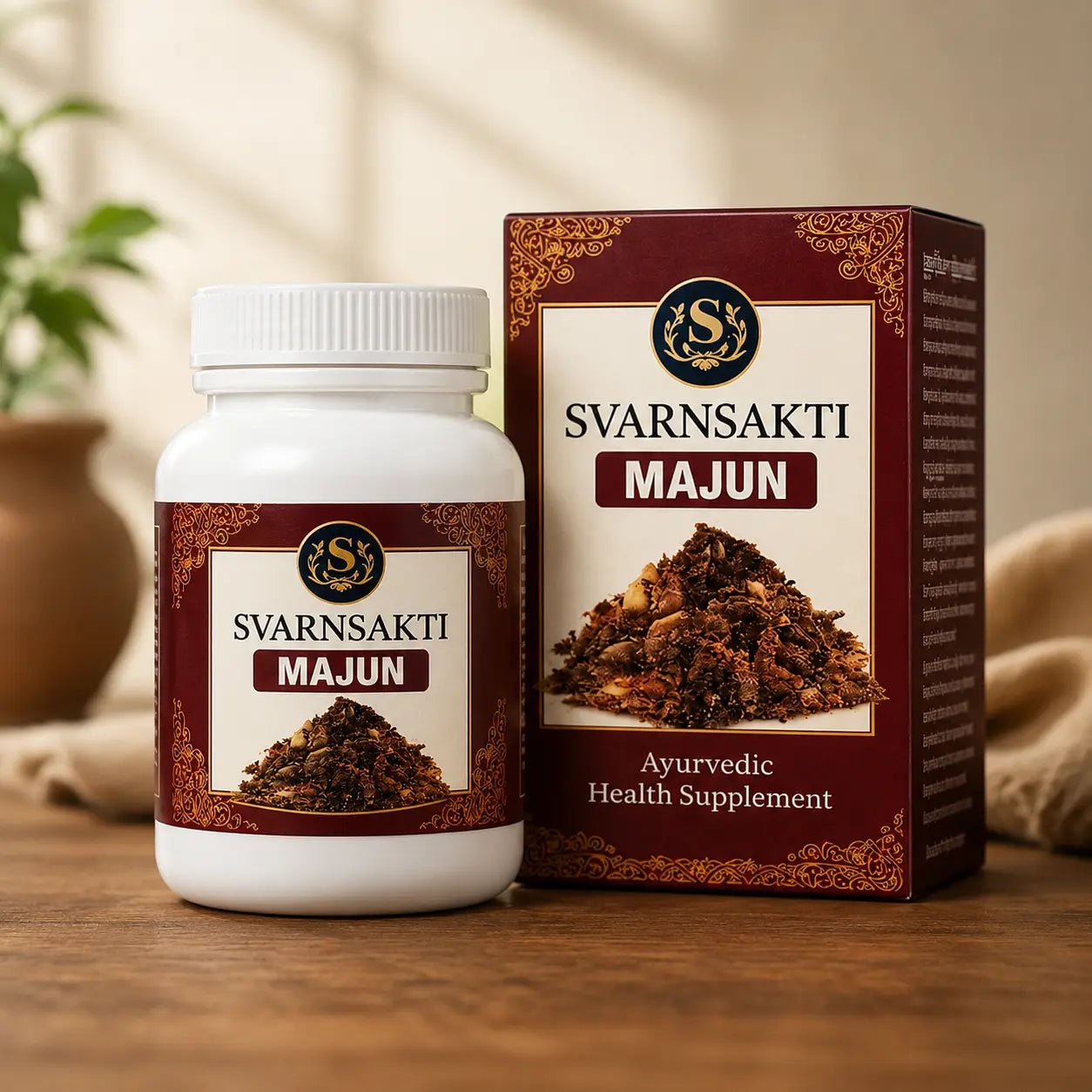
Svarnsakti makes Ayurvedic herbal wellness products. If you prefer an Ayurvedic-style formula, see the Svarnsakti Traditional Ayurvedic Majun Formula, where the full ingredient list is on the product page. Our licence number is [add licence number and issuing authority], and batch lab reports are available at [add link]. Read how to use it in our guide on how to take majun, the 8 majun ingredients explained, and majun with shilajit.
Myths vs facts
|
Myth |
Fact |
|
"Majun is only a Unani product." |
The word is Arabic and Unani, but Ayurveda has its own equivalent, avaleha. In the market, "majun" is used for both. |
|
"Natural means safe for everyone." |
Sugar content, heavy metals in unpurified shilajit and drug interactions are real concerns. |
|
"More herbs means a better product." |
Quality, licence and testing matter more than the length of the list. |
|
"I can test shilajit purity at home." |
Home tests can spot obvious fakes but cannot confirm heavy-metal safety. |
|
"Ayurvedic and Unani products can be mixed freely." |
Combining them without professional advice is not recommended. |
Medical disclaimer
This article is for information about traditional preparations. Traditional preparations are not the same as proven treatments and these products are not a cure, for any disease. Consult a doctor before starting any herbal product especially if you are pregnant, breastfeeding, taking medicines or managing a health condition.


